
Table of Contents
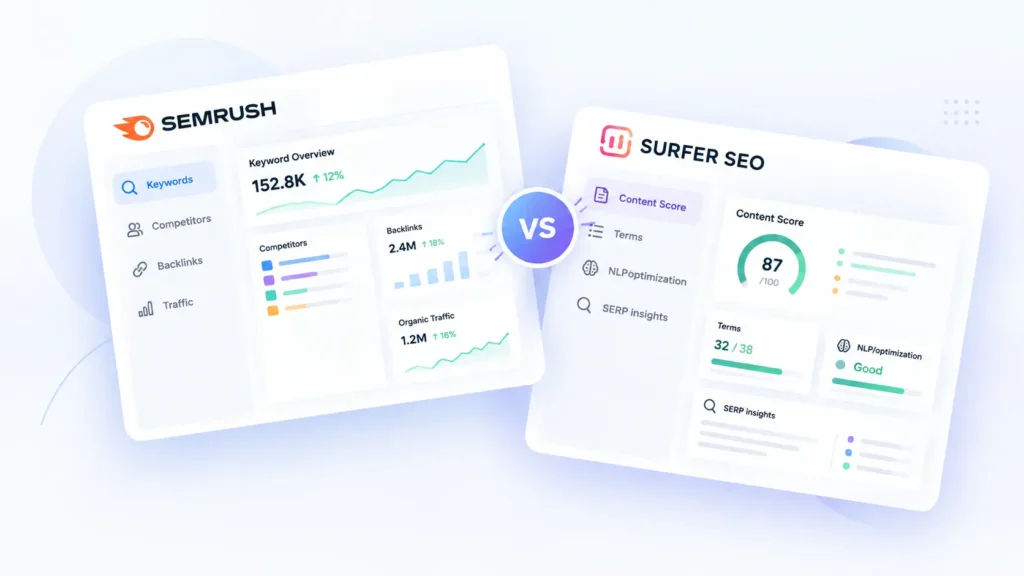
Semrush and SurferSEO stand out as top tools for SEO professionals in 2026. Each one brings unique strengths to keyword research and content strategy. You will find practical examples here to help you decide or combine them effectively.
Keyword Research
Semrush includes the Keyword Magic Tool. This tool quickly finds thousands of keywords. It provides search volume, keyword difficulty, and intent data. You can export keyword clusters to plan your strategy.
For example, enter “best SEO tools 2026.” The tool suggests long-tail keywords like “Semrush vs SurferSEO for agencies.” It also shows CPC data to guide paid campaigns.
SurferSEO focuses on keyword clustering. It groups related terms using data from Google Search Console. This relevance-based grouping helps you spot topical clusters easily.
A pro tip is to cluster keywords around “on-page SEO.” Then create content briefs for each term. This exercise builds strong authority signals. For best results, run clusters weekly. Refresh your evergreen pages this way. You can expect dwell time to increase by 20-30%.
Content Optimization
Semrush offers the SEO Writing Assistant. This tool scores your drafts on readability using the Flesch score. It checks SEO terms and originality too. It suggests fixes in real time. Use it in Google Docs. Paste your outline there. Aim for a score above 80. Add LSI keywords from SERP previews to improve it.
SurferSEO uses a Content Score based on over 500 metrics. It compares term frequency against the top 30 SERPs. For example, optimize an article on “SEO tools review.” The tool flags missing subtopics, such as “AI features.” Add those sections to reach a score of 90 or higher. Agencies report saving 40% on editing time with these content optimisation tools.
On-Page SEO Execution
Semrush creates detailed content briefs. These include heading structures, questions to answer, and image ideas. Import them directly into your CMS for easy use. For a topic like “content strategy,” it suggests H2 headings such as “How to add high-volume keywords with a transactional intent to improve conversion rate?” These match what competitors use.
SurferSEO provides a real-time SEO content editor. It gives NLP guidance, SERP gap analysis, and an AI humanizer. A smart move is to toggle the “Golden Outline” during drafting.
This copies structures from top-ranking pages. After publishing, use auto-linking for internal links. To target E-E-A-T signals, follow its source suggestions. In niche topics, this can lift rankings by 15 positions.
Backlinks and Audits
Semrush leads in backlink analysis. Its Backlink Analytics tool includes a gap finder. The Site Audit scans for over 140 issues, including duplicate content and slow pages. Audit a competitor’s domain. Export 50 or more link ideas each week. Use them in outreach spreadsheets.
SurferSEO handles content audits linked to Google Search Console performance. It flags pages with low optimization scores. Backlink tools are limited here. Pair it with Semrush for full coverage. Run audits after Semrush checks. Prioritize content fixes. Track trends monthly. Start with Core Web Vitals fixes. Expect traffic to increase by 10-20 percent.
AI Tools
Semrush has the Content Toolkit AI. It generates full articles, images, and answers chat prompts with an SEO focus. For example, prompt it with “Write a Semrush vs SurferSEO introduction.” Refine the output with an originality check. This feature works well for high-volume content.
SurferSEO features Surfy AI. It helps with outlines, internal links, and human-like rewrites. Use its AI images for visuals. The link suggester builds topic silos. This feature strengthens topical clusters with little effort. Test AI-generated content against manual versions. Hybrid approaches often deliver 25% more conversions.
Key Features Comparison
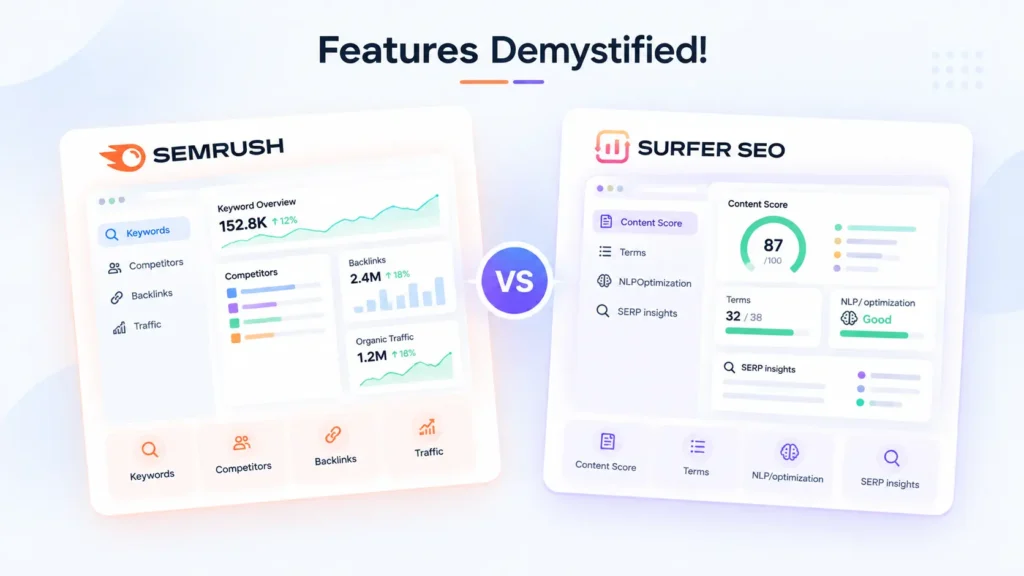
Feature | Semrush | SurferSEO |
Keyword Research | Comprehensive Keyword Magic Tool, gap analysis, and intent data | Keyword clustering strategy, topical maps from GSC |
Content Optimization | SEO Writing Assistant with readability, tone, and originality scores | Content Score from 500+ signals, real-time SEO content editor |
On-Page SEO Execution | Briefs, structure suggestions; integrates with WP/Chrome | SERP gaps, AI humanizer, auto-optimize old content |
Backlinks & Audits | Full backlink analytics, site audit, competitor domain overview | Limited; focuses on content audits via GSC |
AI Tools | Content Toolkit AI, image gen, chat | Surfy AI assistant, AI images, internal linking |
Practical Recommendations
Use Semrush for discovery tasks such as keyword research and backlink analysis. Turn to SurferSEO for polishing content with scores and clusters. Track results through Google Search Console uplifts. SEO agencies benefit from Semrush across client projects.
Use SurferSEO for in-house content. Solo professionals should start with SurferSEO if content creation slows you down.
Conclusion
The Semrush vs SurferSEO comparison for 2026 shows both tools deliver strong results in keyword research and content strategy. Semrush handles end-to-end SEO needs with its broad toolkit. SurferSEO excels in precise on-page optimization.
There is no single winner. Many professionals combine them for hybrid workflows. This approach scales traffic effectively for agencies and independent SEO experts.
Ready to get started? Choose the tool that fits your needs.
Unlock full-suite power for comprehensive SEO.
Optimize content like a pro with real-time guidance.
Frequently Asked Questions
1. What is the main difference in Semrush vs SurferSEO focus?
SurferSEO specializes in content optimization and on-page refinements. It uses SERP analysis and real-time scoring to perfect articles. This multidimensional optimization effectively builds topical authority.
Semrush offers a complete SEO suite. It includes strong backlink analysis, site audits, competitor tracking, and PPC insights. Use it for strategies that go beyond content alone.
2. Which is better for keyword research?
Semrush stands out with its Keyword Magic Tool. It delivers deep metrics, including search volume trends, keyword difficulty scores, intent classification, and organic position tracking, across 26 billion keywords. This extensive coverage makes it ideal for gap analysis and large campaigns.
SurferSEO works well for clustering related terms from Google Search Console. It creates topical maps. However, it does not match Semrush’s overall depth.
3. Can I use both tools together?
Yes, you can, and many agencies do. Begin with Semrush for broad keyword discovery, competitor audits, and backlink opportunities. This initial research lays a solid foundation for the strategy.
Export keyword clusters to SurferSEO next. Use it for precise content optimization, outlines, and live editing. This combination boosts efficiency. It often leads to ranking improvements 30-50% faster.
4. How does pricing compare in 2026?
SurferSEO starts with its Essential plan at $99 per month, billed annually. This plan covers 30 articles. The Scale plan costs $219 for unlimited articles. AI features use credits. It includes a 7-day money-back guarantee.
Semrush Pro starts at $139.95 per month on an annual plan. It provides core features. The Guru plan at $249.95 adds historical data and more users. Semrush offers a 7-day free trial. It suits all-in-one needs but costs more for content-only teams.
5. Do they help with on-page SEO directly?
Both tools support on-page SEO clearly. Semrush uses the SEO Writing Assistant and Content Briefs. These provide structure suggestions, term recommendations, and integrations like WordPress or Chrome.
They make execution smooth during planning. SurferSEO offers a live editor with real-time NLP feedback, SERP gap analysis, and auto-optimizations such as internal linking. It shines for hands-on polishing while writing.